Help AFA raise $250,000 by December 31st – we’re over halfway there!
Support the protection of old-growth forests in BC through Indigenous-led conservation, science, and public action. Donate to help safeguard ancient forests.
https://staging.ancientforestalliance.org/wp-content/uploads/2025/12/yakoun-river-old-growth-spruce-grove-662.jpg
1366
2048
TJ Watt
https://staging.ancientforestalliance.org/wp-content/uploads/2014/10/cropped-AFA-Logo-1000px.png
TJ Watt2025-12-15 15:20:282025-12-15 17:55:17Help AFA raise $250,000 by December 31st – we’re over halfway there!
Chek News: Document reveals approval to harvest remnant old-growth in B.C.’s northwest
BC Timber Sales has ended a policy protecting remnant old-growth in northwest B.C., citing First Nations’ positions, sparking concerns from ecologists and residents.
https://staging.ancientforestalliance.org/wp-content/uploads/2025/12/namhint-valley-logging-bcts-2024-29.jpg
1365
2048
TJ Watt
https://staging.ancientforestalliance.org/wp-content/uploads/2014/10/cropped-AFA-Logo-1000px.png
TJ Watt2025-12-08 13:49:362025-12-08 13:49:36Chek News: Document reveals approval to harvest remnant old-growth in B.C.’s northwest
Thank You to Our Silent Auction business Donors!
Thank you to these local businesses for generously donating items and experiences to our first-ever online Silent Auction!
https://staging.ancientforestalliance.org/wp-content/uploads/2025/10/Artlish-River-Spruce-Issy.jpg
1366
2048
TJ Watt
https://staging.ancientforestalliance.org/wp-content/uploads/2014/10/cropped-AFA-Logo-1000px.png
TJ Watt2025-12-08 13:17:322025-12-08 13:50:51Thank You to Our Silent Auction business Donors!
Statement on the Provincial Forest Advisory Council’s Interim Report – AFA & EEA
The Provincial Forest Advisory Council’s (PFAC) interim report falls short of addressing the root causes of BC’s forestry crisis or outlining the bold, decisive actions needed to reverse it, warn the Ancient Forest Alliance (AFA) and Endangered Ecosystem Alliance (EEA).
https://staging.ancientforestalliance.org/wp-content/uploads/2025/09/3-Giant-Cedar-Log-Nahmint-Valley.jpg
1365
2048
TJ Watt
https://staging.ancientforestalliance.org/wp-content/uploads/2014/10/cropped-AFA-Logo-1000px.png
TJ Watt2025-11-21 10:13:452025-11-21 10:15:43Statement on the Provincial Forest Advisory Council’s Interim Report – AFA & EEA
Conservationists Welcome NDP Government’s Big Tree Protection Announcement, Set Sights on More Comprehensive Old-Growth Plan
/in Media ReleaseVictoria, BC – The Ancient Forest Alliance (AFA) welcomes the NDP government’s announcement that it will protect 54 of the biggest trees listed on the BC Big Tree Registry with buffer zones and hopes for more comprehensive, science-based old-growth forest protection under the BC government’s proposed old-growth strategy.
“We welcome this positive step toward protecting some of the biggest and oldest trees on Earth,” stated Ancient Forest Alliance campaigner Andrea Inness. “It’s a small step, but it may signal there’s more comprehensive action to come.”
“The BC government’s old-growth plan must now be scaled up exponentially. We need protection at all spatial scales: at the tree, grove, landscape unit/watershed, and ecosystem level.”
“We’re glad to hear the 54 trees will be protected with buffer zones, which, although small in this case at only one hectare, are vital to minimize the risk of damage due to factors exacerbated by surrounding harvesting activities, such as strong winds, and to enhance ecosystem protection and tourism value.”
“The NDP’s approach to protecting big trees should not be based only on trees listed on the BC Big Tree Registry, though, which is a small subset of BC’s biggest trees based on what some big tree enthusiasts have found. Many of BC’s biggest trees are not on the big tree registry.”
The AFA also welcomes the NDP’s commitment to change regulations later this year to protect more of BC’s biggest trees. If effective, such a legal mechanism would help protect the environmental, recreational, and cultural values of BC and could bolster BC’s tourism industry, significantly enhancing the province’s status as a preferred destination for nature-lovers far and wide.
“It’s important they get the details right, though,” stated AFA campaigner and photographer TJ Watt. “These regulatory protections must include adequate buffer zones of at least 2 hectares and must avoid loopholes that allow big trees to be logged in certain circumstances. The minimum size thresholds for protection should also be lowered, as 50% of the diameter of the widest trees found still only captures the most extremely rare, exceptionally big trees.”
“It must also be a comprehensive policy that’s rolled out across BC’s coast and expanded to the Interior.”
The AFA is hopeful the NDP’s big tree protection regulations will also be expanded to include protection of BC’s “grandest groves,” where there is an exceptional number and density of large trees, to ensure ancient forests with the greatest ecological, recreational, and scenic values are conserved for future generations to enjoy.
“BC’s biggest trees and grandest groves truly stand out as some of the province’s most spectacular natural assets and are disproportionately valuable for tourism and often for biodiversity. But much more work is needed to protect old-growth forests on a much greater scale.”
“A more comprehensive, legislated plan is still desperately needed to protect the province’s old-growth ecosystems on a larger scale in order to sustain biodiversity, clean water, and the climate,” stated Inness.
The AFA is hopeful the NDP government’s consultation process and resulting old-growth strategy result in such legislated changes, for example, through amendments to the Forest and Range Practices Act in the spring of 2020.
“The next step, however, should be immediate moratoria on logging of old-growth ‘hotspots’ with the highest ecological and recreational value. Otherwise the grandest, most intact forests will continue to be whittled away while the government figures out its old-growth plan.”
“To sustain forestry jobs, the BC government must also ensure the development of a sustainable, value-added second-growth forest industry and end the export of vast amounts of raw, unprocessed logs to foreign mills.”
“Today’s announcement is like the bang of the starting gun at the beginning of the race. It kicks things off. Let’s just hope there are much more exciting things to come and that the NDP’s old-growth strategy is a sprint, not a marathon that drags on for years. Time is running out for the last of BC’s remaining productive old-growth forests and we need province-wide, science-based solutions fast.”
In the press release accompanying today’s announcement, the NDP government claimed that 55% of the old-growth on BC’s coast is protected. This figure is highly misleading for a number of reasons. The BC government is including vast areas of low-productivity sub-alpine and bog forests with little to no commercial value, which aren’t endangered, and are ignoring largely cut-over private lands, which make up almost 25% of Vancouver Island’s land base. They also lump the Great Bear Rainforest (where 85% of forests have been set aside from commercial logging) in with the south coast, where old-growth forests are highly endangered and where old-growth logging continues at a scale of about 10,000 hectares a year.
Finally, the BC government fails to mention how much old-growth has previously been logged on the south coast: almost 80% of the original productive old-growth forest and over 90% of the low elevation, high-productivity stands (e.g. the very rare, monumental old-growth stands currently being logged in the Nahmint Valley and other hotspot areas).
“By focusing only on the fraction of old-growth protected of the fraction remaining, the more old-growth forest that’s logged outside the 55% that’s protected, the higher that number rises,” stated Inness. “If all the unprotected old-growth forests are logged, the BC government could then make the claim that ‘100% of the old-growth forests on the coast are protected!’”
UBC scientists find high mutation rates generating genetic diversity within huge, old-growth trees
/in News CoverageUBC News
July 8th, 2019
Study provides clues on how trees evolve to survive
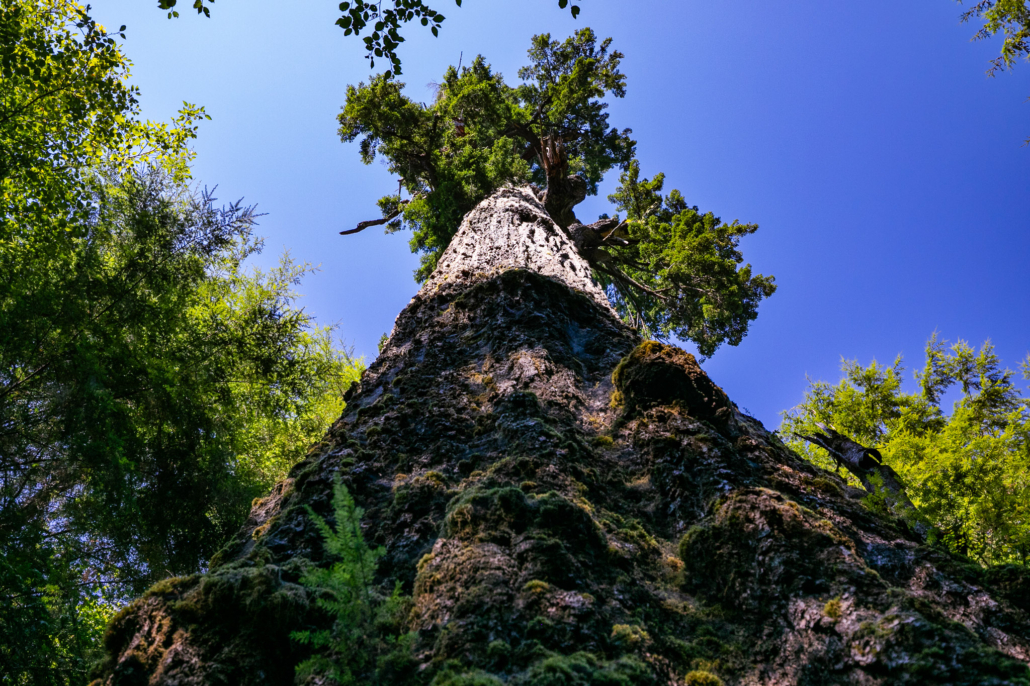
The towering, hundreds of years old Sitka spruce trees growing in the heart of Vancouver Island’s Carmanah Valley appear placid and unchanging.
In reality, each one is packed to the rafters with evolutionary potential.
UBC researchers scraped bark and collected needles from 20 of these trees last summer, sending the samples to a lab for DNA sequencing. Results, published recently in Evolution Letters, showed that a single old-growth tree could have up to 100,000 genetic differences in DNA sequence between the base of the tree, where the bark was collected, and the tip of the crown.
Each difference represents a somatic mutation, or a mutation that occurs during the natural course of growth rather than during reproduction.
“This is the first evidence of the tremendous genetic variation that can accumulate in some of our tallest trees. Scientists have known for decades about somatic mutations, but very little about how frequently they occur and whether they contribute significantly to genetic variation,” said Sally Aitken, the study’s lead researcher and a professor of forestry at UBC. “Now, thanks to advances in genomic sequencing, we know some of the answers.”
The researchers chose the Sitka spruce because it’s among the tallest trees growing in the Pacific Northwest, and sampled the exceptional trees in Carmanah Walbran Provincial Park.
“Because these trees live so long and grow so tall, they’re capable of accumulating tremendous genetic variation over time,” explained Vincent Hanlon, who did the research as part of his master of science in the faculty of forestry at UBC.
“On average, the trees we sampled for the study were 220 to 500 years old and 76 metres tall. There’s a redwood tree in California that’s 116 metres tall, but these Sitka spruce were pretty big.”
The researchers say more time and further studies will be needed to understand exactly how the different somatic mutations will affect the evolution of the tree as a species.
“Most of the mutations are probably harmless, and some will likely be bad,” explained Aitken. “But other mutations may result in genetic diversity and if they’re passed onto offspring they’ll contribute to evolution and adaptation over time.”
Studying somatic mutation rates in various tree species can shed light on how trees, which can’t evolve as rapidly as other organisms like animals due to their long lifespans, nonetheless survive and thrive, Aitken said.
“We often see tree populations that adapt well to local climates and develop effective responses to changing stresses such as pests and bugs,” she added. “Our study provides insights on one genetic mechanism that might help make this possible.”
See the original article
ACTION ALERT: Have Your Say on Changes to BC’s Forest Practices Legislation
/in Take ActionThe BC Government is currently seeking public feedback on proposed changes to the Forest and Range Practices Act, the main piece of legislation governing forest practices in BC. The amendments will focus on issues like climate change, biodiversity, government oversight, and public trust in forestry management decisions.
This is a rare and critical opportunity for British Columbians to speak up for science-based protection of BC’s endangered old-growth forests!
The Forest and Range Practices Act (FRPA) has reduced government accountability and oversight and put the fox (timber industry) in charge of the henhouse (BC’s public lands, including rare and endangered old-growth forests). It also prioritizes timber supply over all other forest management objectives and includes loopholes around old-growth protection big enough to drive a logging truck through! The results have been a disaster and BC’s ancient forest ecosystems, biodiversity, climate, and communities are paying the price.
Now is our chance to demand bold and sweeping changes to this outdated law.
Current legislated targets for old-growth protection are set too low and are not based on science, meaning we are losing the species, ecosystem services, tourism and recreation opportunities, and valuable carbon stores that old-growth forests provide. It’s high time the NDP government stopped placating the timber industry and started prioritizing the health and resilience of BC’s forest ecosystems. And it starts with strengthening the Forest and Range Practices Act.
Amendments to FRPA must:
Read the BC government’s discussion paper for more information and details on the proposed changes.
Until Monday, July 15th, the BC government is accepting public comments on amendments to FRPA through an online survey. We have provided responses to the survey questions below to make it as easy as possible for you -simply copy, paste, and edit your responses as needed.
SUBMIT YOUR FEEDBACK (suggested survey answers below) Question 1. How should the Province identify opportunities and priorities for adapting forest management to a changing climate, such as mitigating the effects of beetle infestations, drought and fire?
Question 2. What factors should be considered in the planning of forest operations to reduce the risks of wildfire around your community?
Question 3. A vital step in landscape-level planning is understanding what is important to the public. Based on what is important to you or your community, what information on the condition of resource values (such as species-at-risk habitat) do you think is necessary to support the planning process?
Question 4. How would you like to be involved in the planning process?
Question 5. Resource roads are a valuable asset in the province as they provide access for the forest industry, ranchers, other resource users, and the public for commercial and recreation purposes. Yet, these same road networks are costly to maintain and have potential negative impacts on wildlife, water quality and fish habitat. What values do you believe are important to consider when planning new roads, road use and maintenance, and deactivation in your area?
Question 6. How can the Province improve transparency and timelines of information regarding proposed operational and landscape-level objectives, plans and results?
Question 7. What information will help inform your feedback on plans that may impact you, your community or your business (e.g., maps of cutblocks and roads planned in your area, hydrological assessments, wildlife habitat areas or recreation opportunities, etc.)?
Question 8. What additional values should be considered in FRPA that will allow us to manage forest and range practices in a better way?
FRPA amendments must also:
Question 9. In what ways should the Province strengthen government oversight and industry accountability regarding forest and range activities to better address the challenges of climate change and the interests of all British Columbians?
Thank you for submitting your feedback! Can you go a step further?
Send an email to Forests Minister Doug Donaldson, Premier John Horgan, and other decision-makers telling them the 2020 Forest and Range Practices Act amendments must include science-based protection of old-growth forests!